
Why Bond Prices Fall When Yields Rise
Fixed coupons are worth less when new bonds pay more, so prices fall until yields match. A 4% 10-year bond drops about 7.7% if yields rise to 5%. Why it occurs.
Bond prices fall when yields rise because coupons are fixed: if new bonds pay more, an older bond only sells at a lower price, low enough that its yield matches the market. A 10-year 4% bond priced at $1,000 falls to about $923, roughly 7.7%, if yields rise to 5%, and rises to about $1,085 if they fall to 3%.
Worked example
- Bond: $1,000 face value, 4% annual coupon, 10 years
- Market yield 4% → price $1,000
- Market yield 5% → price ≈ $922.78 (−7.7%)
- Market yield 3% → price ≈ $1,085.30 (+8.5%)
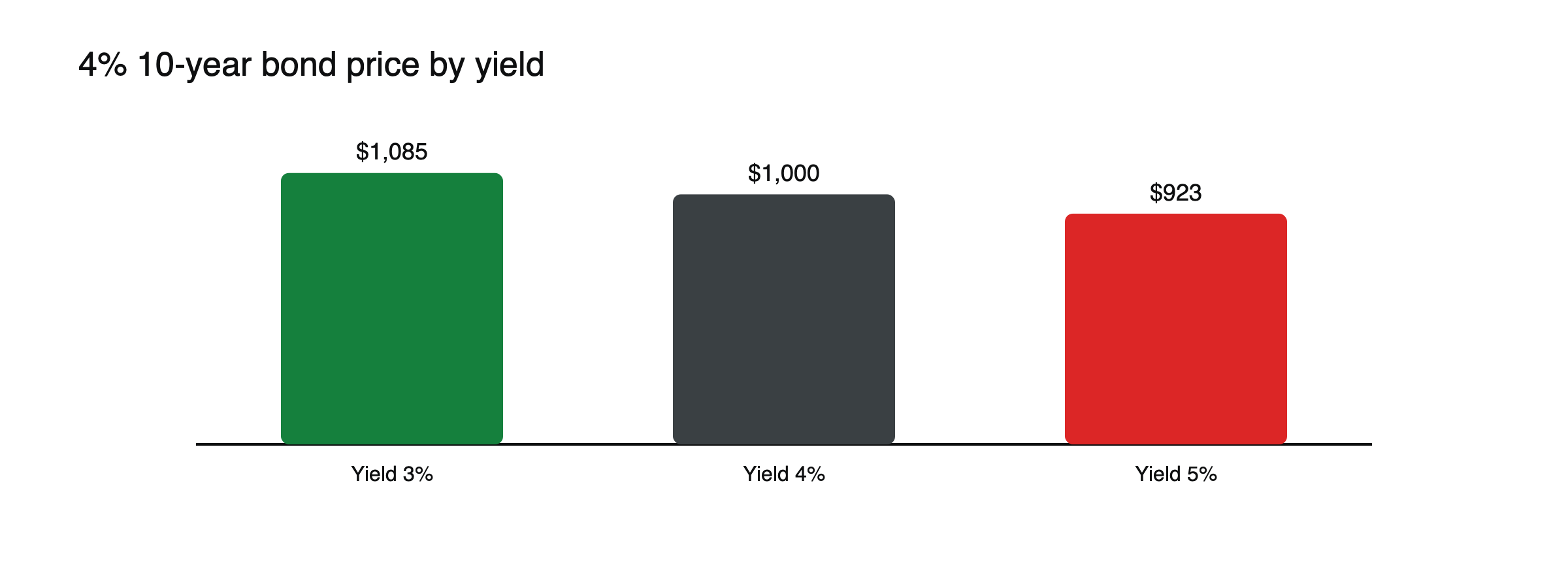
Figure: Price moves opposite to yield (example values).
(Example values.)
The price at different yields
| Market yield | Price of a 10-year 4% bond | Change from par |
|---|---|---|
| 2% | About $1,179.65 | +18.0% |
| 3% | About $1,085.30 | +8.5% |
| 4% | $1,000.00 | 0% |
| 5% | About $922.78 | −7.7% |
| 6% | About $852.80 | −14.7% |
(Example values, annual coupons.) A fall of 1 point in yields raises the price more than a 1-point rise lowers it, an effect called convexity, which works in the holder’s favor.
Why longer bonds move more
The further away the cash flows, the more a change in yield affects their value today. In 2022, 2-year Treasuries lost about 4% while 10-year Treasuries lost about 16%. See how bond duration predicts price moves.
Zero-coupon bonds
A zero-coupon bond pays no interest; it is sold at a discount and repays face value at maturity. A 10-year zero priced to yield 4% costs about $675.56; if yields rise to 5%, it falls to about $613.91, a drop of about 9.1%, more than the 7.7% fall of the 4% coupon bond. With no coupons along the way, all of its value comes at the end, so it is more sensitive to yields.
What moves yields
Central bank policy, inflation expectations, growth and government borrowing. See how central bank decisions move currencies for the policy side.
2022 as the extreme case
As the Fed raised rates fast, the 10-year Treasury yield rose from about 1.5% to about 4.2%, and the main US bond index lost 13%, its worst year since 1976.
Coupon versus yield
The coupon is fixed when the bond is issued; the yield changes with the price. A bond with a 2% coupon bought at $850 may yield over 4% to maturity, while a 6% coupon bond bought at $1,150 may yield less than its coupon. Comparing bonds by yield to maturity, rather than by coupon, shows which actually pays more. See how to calculate yield to maturity.
Holding to maturity
Price changes matter most to those who sell before maturity. An investor who holds a high-quality bond to maturity receives its coupons and face value regardless of interim price moves. In 2022, investors who held individual bonds to maturity saw paper losses but still received full repayment, while those who sold, or held funds that never mature, realized the losses or saw them reflected in fund prices.
The other side
Higher yields mean higher future income; bonds bought after yields rise earn more. See how bonds work.
Rising yields and future income, illustrated
Suppose an investor holds a bond fund yielding 1.5% when rates jump and the fund’s price falls 10%. (Example values.) The fund now buys new bonds yielding about 4.5%, so its income roughly triples over time as old bonds mature and are replaced. After several years, the higher income can make up for the initial loss for a patient holder. Rising yields hurt today’s prices but improve tomorrow’s returns.
Yields and other markets
Bond yields affect almost every other market. Rising yields raise borrowing costs for companies and households, reduce the value of distant company profits and can strengthen the currency. See how interest rates affect stock prices.
Clean and dirty prices
Bond prices are usually quoted clean, without the coupon interest that has built up since the last payment. A buyer pays the clean price plus accrued interest, together called the dirty price. For a bond with a 4% annual coupon, about $10 of interest per $1,000 accrues every three months, so a bond quoted at $1,000 three months after a coupon date costs about $1,010 in total. (Example values.) Quoting clean prices keeps price charts from jumping around coupon dates.
Spreads over government bonds
Corporate bond yields are often described as a spread over a government bond of similar maturity. If a 10-year Treasury yields 4% and a company’s 10-year bond yields 5.5%, the spread is 1.5 points, compensating for credit risk and lower liquidity. Corporate bond prices can therefore fall even when government yields are steady, if spreads widen on worries about the economy. See what a credit spread is.
Inflation and yields
Investors demand yields that cover expected inflation plus a real return. When inflation expectations rise, yields tend to rise and bond prices fall, even if the central bank has not moved. The gap between ordinary and inflation-linked bond yields shows what inflation markets expect. See what breakeven inflation is.
Flight to safety
In market panics, investors often buy government bonds, pushing their prices up and yields down, even as shares fall. That pattern makes high-quality bonds useful diversifiers in many downturns, though not when inflation is the main threat, as in 2022, when bond and share prices fell together.
Common misreadings
- Treating the coupon as the yield.
- Assuming bonds cannot fall in value.
A bond fund in a rising-rate year, illustrated
Suppose an investor holds $10,000 in a bond fund with a duration of 6 when yields rise 2 points over a year. The price effect is roughly −12%, about −$1,200, partly offset by a year of income, perhaps $250 at a starting yield of 2.5%. The fund ends the year down about 9.5%. (Example values.) The following year, the fund’s higher yield, now around 4.5%, earns about $450 if rates stop rising, beginning the slow recovery.
Short bonds barely move
A 2-year 4% bond falls only to about $981.41 if yields rise to 5%, less than 2%, because its money comes back soon and can be reinvested at the higher rate. Short bonds and Treasury bills are therefore used to hold cash safely when rates are expected to rise. See Treasury bills, notes and bonds compared.
Long bonds in falling-rate periods
The same sensitivity works in reverse. A 30-year 4% bond would rise to about $1,196 if yields fell to 3%, and to about $1,448 if they fell to 2%. Long bonds can deliver large gains when rates fall sharply, which is why they are popular with traders betting on rate cuts and with investors seeking protection against recessions.
Reading yield moves in the news
Market reports often describe bond moves in basis points, hundredths of a percentage point. A rise of 15 basis points in the 10-year yield means 0.15 points, which for a 10-year bond with a duration of about 8 implies a price fall of about 1.2%. Moves of 10 to 20 basis points in a day are common around major data and central bank meetings; moves of 30 or more signal a significant shift in expectations. Translating basis points into price changes makes news about bonds easier to judge. Many traders keep a simple mental table of these conversions for the bond maturities and markets they follow most closely each day.
Frequently asked questions
If prices fall when yields rise, why buy bonds when rates are low?
For income, stability and diversification. But low starting yields leave less cushion against rising rates, as 2022 showed.
Do all bonds react the same way?
No. Longer and lower-coupon bonds react more; corporate bonds also react to credit concerns.
Leverage, margin and cost figures in this article are example values for illustration. Actual terms depend on the provider, the instrument and the rules in your country.
This article is educational content and does not constitute financial, investment, legal or tax advice. Digital assets are volatile and you may lose the amount you invest.
Sources
- Why ordinary investors got hit so hard in 2022 (Bloomberg US Aggregate −13.1% through December 28, worst since 1976; 10-year yield from about 1.5% to about 4.2%) — Yahoo Finance Morning Brief, December 2022
- Bonds: a H1 2023 report card (2022 Treasury returns from −4.1% for 2-year to −16.3% for 10-year; investment grade nearly −16%) — WisdomTree
- Largest bond discount in decades (Agg average bond price about $93.25; yield-to-worst 4%–5%; prices and yields move inversely) — Landmark Wealth Management