
Why Tech Stocks Are So Sensitive to Bond Yields
Tech and growth stocks earn more of their expected profits far ahead, so rising bond yields cut their value more. How the duration effect works, with 2022.
Tech stocks are sensitive to bond yields because much of their value comes from profits expected far ahead. When yields rise, those distant profits are discounted more heavily, so their value falls more than for steady earners. The tech-heavy Nasdaq fell more than 9% in January 2022 as yields rose, its worst month since March 2020.
The duration effect
A bond with a long maturity loses more value when yields rise than a short one. Growth stocks behave like long-duration assets: most of their expected cash flows lie far out, so a higher discount rate hits them harder.
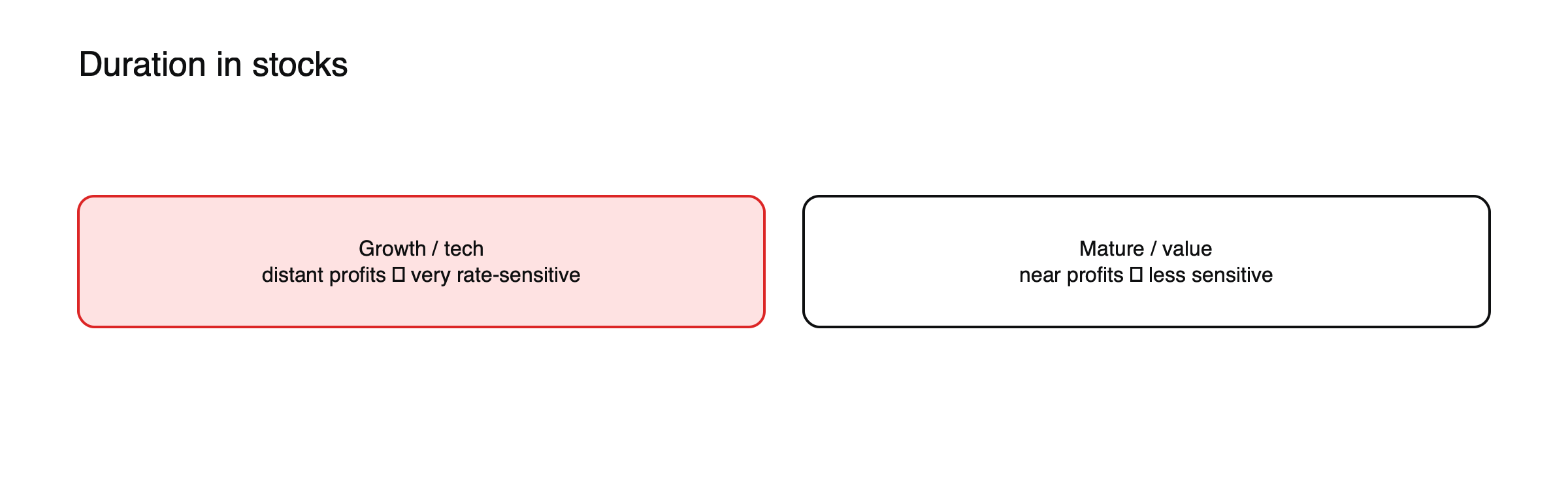
Figure: Why growth stocks react more to yields.
Duration in numbers
Compare two hypothetical companies. One expects a single profit of $100 in 15 years; the other expects $10 a year for the next 10 years. If investors discount at 8%, the first is worth about $31.50 and the second about $67.10. If the discount rate rises to 9%, the first falls to about $27.50, a drop of nearly 13%, while the second falls to about $64.20, only about 4%. (Illustrative figures.) The further away the profits, the larger the hit from the same rise in rates.
Real yields matter most
Inflation-adjusted, or real, yields measure the true return on safe money. Sharp rises in real yields have tended to hit unprofitable and high-valuation tech hardest. See why real yields matter for gold, stocks and crypto.
2022 as an example
As the Fed raised rates and yields climbed through 2022, US equities fell about 18%, with growth and tech shares among the weakest. Spending-heavy tech firms were punished, as Meta was in February 2022.
January 2022
As markets priced in faster rate hikes at the start of 2022, the technology-heavy Nasdaq index fell more than 9% in January, its worst month since March 2020. Many unprofitable technology companies fell much further, some losing more than half their value during the year, while large, profitable technology firms fell less.
Profitable versus unprofitable technology
Companies that are already highly profitable, with strong cash flows today, behave more like mature businesses than like long-duration assets. Early-stage companies that expect profits only years from now are the most sensitive to rates, and also depend on investors’ willingness to fund them. When rates rise, raising money becomes more expensive and harder, adding a second source of pressure.
When the link weakens
Strong earnings growth can offset higher yields, as with companies benefiting from new technology trends. Profitable large tech companies with cash on hand are less sensitive than early-stage firms.
2023: growth beats yields
The link can be overwhelmed by earnings growth. In 2023, US bond yields stayed high and at times rose further, yet Nvidia’s shares rose about 239% over the year, driven by surging demand for its artificial intelligence chips. In May 2023, it guided to about $11 billion of next-quarter revenue against a consensus of about $7.2 billion. When expected earnings rise fast enough, they can more than offset a higher discount rate.
Tracking yields alongside tech
Traders often watch the 10-year Treasury yield and the 10-year inflation-protected yield on the same screen as a technology index. Days when real yields jump by more than a few hundredths of a percentage point often see technology underperform, especially early-stage companies. Over months, the gap between technology and the broader market tends to widen when real yields fall and narrow when they rise.
What it means for traders
Watch 10-year and real Treasury yields alongside tech earnings. A yield spike can move tech CFDs even without company news. See how interest rates affect stock prices and what moves stock prices.
The Nasdaq and the S&P 500
Because the Nasdaq 100 is heavily weighted toward technology and growth companies, it usually reacts more to yield changes than the broader S&P 500. Index CFD traders often see the Nasdaq move one and a half to two times as much as the S&P on days driven by rate news. See how stock index CFDs work.
Earnings days for large technology companies
Results from the largest technology companies combine company news with rate sensitivity. A strong report can lift a share even on a day of rising yields, while a disappointing one on such a day can produce an outsized fall. Holding positions through these reports carries both sets of risks at once.
The rate-cut rally
The same sensitivity works in reverse. When markets begin to expect interest rate cuts, falling yields can lift technology shares sharply, sometimes before any cut happens. Rallies in growth shares have often begun when bond yields peaked. As with rate rises, the reason for cuts matters: cuts that come with a recession can hurt technology earnings enough to offset the benefit of lower rates.
How concentrated the market has become
A handful of very large technology companies now make up a large share of major US indices. That concentration means rate-driven moves in technology can move the whole market. It also means that the earnings of a few companies can lift or sink indices on their own, combining company-specific risk with rate risk for index traders.
Funding for young companies
Higher interest rates also affect technology through financing. When money is cheap, investors readily fund unprofitable companies in exchange for future growth; when rates rise, funding becomes scarcer and costlier, and companies must cut spending or raise money on worse terms. That pressure can show up in slower growth, layoffs and lower valuations across the sector.
Common misreadings
- Treating all technology companies as equally rate-sensitive.
- Watching nominal yields but ignoring real yields.
- Assuming falling yields always lift technology shares.
A yield-shock day, illustrated
Suppose US inflation data come in above expectations and the 10-year inflation-protected yield jumps 0.15 percentage points in a day. (Illustrative scenario.) The broad S&P 500 falls 1.5%, the Nasdaq 100 falls 2.5%, large profitable technology companies fall about 2% and a basket of unprofitable growth companies drops 6%. No company reported news; the whole move came from the change in the discount rate. Days like this show why traders watch yields before trading technology shares.
Positioning around rate events
Inflation releases, jobs reports and central bank meetings can all move yields sharply, and technology shares with them. Traders holding technology positions often reduce size before these events or set wider stops, treating them like earnings dates for the sector as a whole. Combining an economic calendar with company earnings dates gives a fuller picture of event risk. See how to read an economic calendar.
Technology outside the United States
Technology shares in Europe and Asia are also sensitive to US yields, because they compete for the same global investors and are often valued against US peers. Semiconductor makers in Asia add their own cycle of inventory and demand, so their shares can react to both rates and chip orders. Watching both rates and the global chip cycle gives a fuller picture of what drives these shares today.
Frequently asked questions
Why are growth stocks compared to long-term bonds?
Because most of their value comes from cash flows far in the future, so, like long-term bonds, their value changes more when interest rates move.
Do falling yields always lift tech stocks?
Often, but not always. If yields fall because of recession fears, weaker earnings expectations can outweigh the benefit of lower rates.
This article is educational content and does not constitute financial, investment, legal or tax advice. Digital assets are volatile and you may lose the amount you invest.
Sources
- Meta shares plummet on tepid forecast (Nasdaq fell more than 9% in January 2022, worst month since March 2020) — Reuters via Euronews
- Commodities are more than just an inflation hedge (US equities −18% in 2022) — WisdomTree
- What’s behind the divergence between gold and real Treasury yields? (real yields as a key driver) — Janus Henderson
- Why Nvidia stock skyrocketed 239% in 2023 (Q2 revenue guidance of $11 billion vs $7.2 billion consensus; shares +24% on May 25, 2023) — The Motley Fool, January 2024