
How Central Bank Gold Buying Affects the Price
Central banks bought 1,045 tonnes of gold in 2024 and 863 in 2025, a price-insensitive demand that helped push gold to records. Why they buy and the risks.
Central bank gold buying has become one of gold’s biggest drivers. Central banks bought 1,045 tonnes in 2024 and 863 tonnes in 2025, far above pre-2022 levels. Because they buy for strategic reasons rather than short-term returns, their demand creates a steady floor and weakened gold’s link to interest rates.
Why central banks buy
- Diversifying reserves away from the US dollar.
- Sanctions risk: gold held at home cannot be frozen the way foreign-currency deposits can, a concern that grew after 2022.
- Inflation and fiscal worries in major economies.
- No credit risk: gold is no one’s liability.
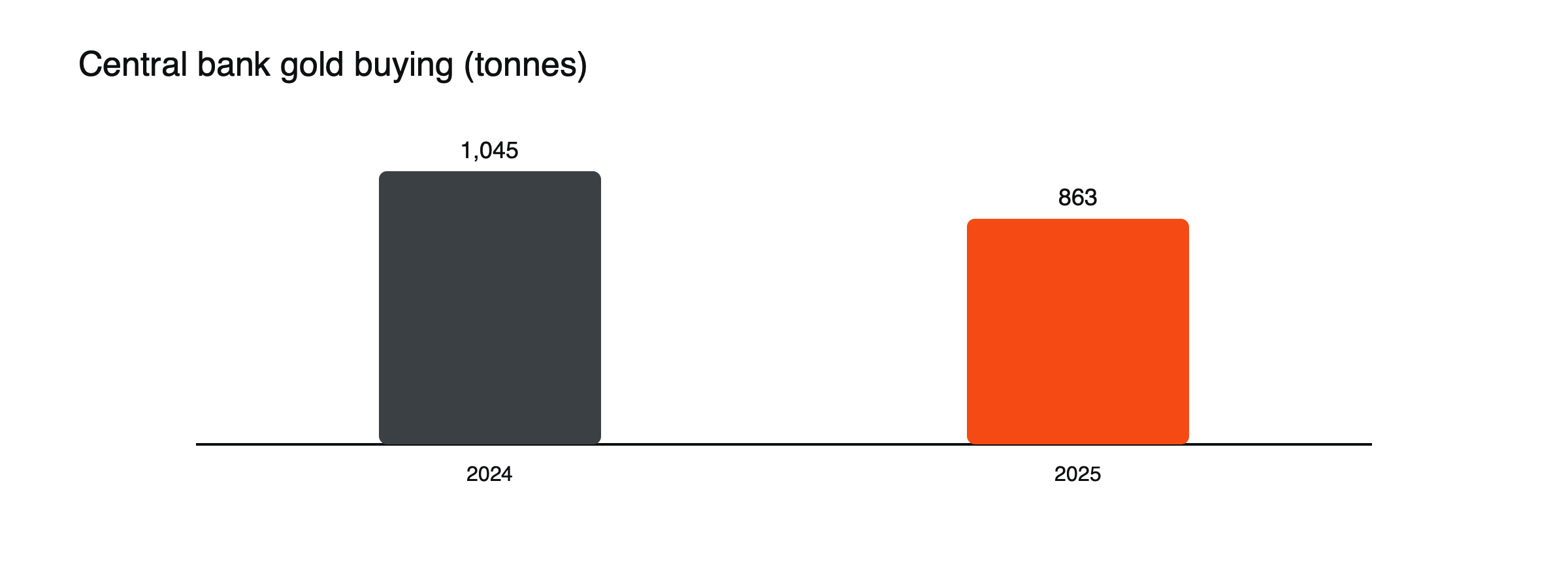
Figure: Central bank gold buying. Source: World Gold Council via Aerapass.
The numbers over time
| Period | Central bank purchases |
|---|---|
| 2022–2024 combined | About 2,971 tonnes |
| 2024 | About 1,045 tonnes |
| 2025 | About 863 tonnes, roughly 72 tonnes a month on average |
| January 2026 | About 5 tonnes |
(Figures as reported by the World Gold Council and summarized in market commentary.) Buying of around 1,000 tonnes a year in 2022 to 2024 was roughly double the pace of the previous decade, which is why it is seen as a turning point for the gold market.
How purchases are reported
Central banks report their reserves to the International Monetary Fund, and the World Gold Council compiles and estimates purchases from that data and other sources. Not all buying is reported promptly, and some purchases appear only in estimates of unidentified buying. As a result, monthly figures can be revised, and the market sometimes learns of large purchases with a delay.
Who is buying
Purchases have been led by emerging-market central banks, including Poland, India, China, Turkey and Kazakhstan.
How it moves the price
Large, steady and price-insensitive buying absorbs supply and supports prices on dips. In a 2026 survey, almost 90% of central banks expected global reserves of gold to rise over the next year.
Gold’s share of reserves
For many emerging-market central banks, gold makes up a small share of total reserves compared with large holders in Europe and North America, whose gold holdings date back decades. Part of the recent buying reflects a wish to move closer to those levels. Even modest increases in gold’s share of large reserve portfolios translate into hundreds of tonnes of demand.
Where the gold is kept
Some central banks hold gold at home; others keep it in vaults abroad, often in London or New York. Concerns about access in a crisis, and about sanctions, have led some to bring gold home. Where gold is stored does not change the price directly, but it reflects the same strategic motives that drive buying.
Risks to the story
Purchases can slow, as in January 2026, when buying dipped to about 5 tonnes; some buyers pause at high prices; and gold remains volatile, falling from above $5,200 in February 2026 to near $4,060 by late June.
See what moves gold prices, why gold falls when real yields rise and how commodity CFDs work.
What could change the trend
Central banks could slow purchases if prices rise so far that buying becomes expensive, if their reserves shrink because of currency defense or if political concerns about the dollar ease. Some central banks also sell gold at times, for example to support their currencies or meet funding needs. A sustained slowdown in buying would remove one of the main supports of recent years, though it would not necessarily reverse prices on its own.
What it means for traders
Central bank demand is a slow, structural force rather than a daily trading signal. It tends to support prices on dips, which can make sharp falls shorter, but it does not prevent large swings, as the move from above $5,200 to around $4,060 in 2026 showed. Monthly and quarterly data releases on central bank purchases can move sentiment, especially when they show a clear acceleration or slowdown. See what moves gold prices.
From sellers to buyers
Central banks were not always buyers. In the 1990s and early 2000s, several European central banks sold large amounts of gold, and in 1999 a group of them agreed to limit their combined sales to avoid flooding the market. After the 2008 financial crisis, the picture reversed: central banks as a group became net buyers, and purchases accelerated sharply from 2022. The shift from a source of supply to a major source of demand is one of the biggest structural changes in the gold market in decades.
Sanctions and reserves
In 2022, a large part of Russia’s foreign currency reserves held abroad was frozen by Western governments. For many central banks, the episode showed that reserves held in other countries’ currencies and financial systems could become unavailable in a political conflict. Gold held in a country’s own vaults carries no such risk, which helped explain the sharp rise in purchases that followed.
Sensitivity to price
Central bank buying is less sensitive to price than investor demand, but it is not entirely indifferent. When prices jumped in early 2026, purchases slowed, with buying in January estimated at only about 5 tonnes. Some central banks prefer to buy on dips, spreading purchases over time. That behavior helps explain why their demand can cushion falls without preventing them.
What reserve managers expect
Surveys of reserve managers give a sense of future demand. In a 2026 survey by the World Gold Council, almost 90% of central banks said they expected global central bank gold reserves to increase over the following year. Such expectations do not guarantee purchases, but they suggest the strategic case for gold remains strong among those who manage national reserves.
The largest holders
The biggest official gold reserves belong to the United States, Germany, Italy and France, largely built up decades ago when gold played a central role in the monetary system. For these countries, gold makes up a large share of total reserves. Most recent buying has come from emerging economies with much smaller gold shares, which is why their purchases are seen as a long-term catch-up rather than a short-term trade.
Buying and the dollar’s role
The dollar remains by far the largest reserve currency, and central bank gold buying does not mean it is being abandoned. But shifting even a few percentage points of reserves from dollar assets into gold creates large demand for a market of gold’s size. Analysts watch this diversification as a slow-moving trend that can support gold over years, while day-to-day prices respond to interest rates, the dollar and investor flows. Monthly and quarterly summaries of central bank activity published by the World Gold Council are among the most closely read reports in the gold market. A clear acceleration or slowdown in buying can shift market sentiment for several weeks, even though the figures describe purchases made months earlier.
Frequently asked questions
Do central banks buy gold to make a profit?
Mostly not. They buy to diversify reserves, reduce reliance on any one currency and hold an asset without credit risk, which is why their buying is less sensitive to price than that of investors.
Can central banks move the gold price on their own?
Their buying is large enough to influence prices over time, but investor flows, interest rates and the dollar usually drive day-to-day moves.
This article is educational content and does not constitute financial, investment, legal or tax advice. Digital assets are volatile and you may lose the amount you invest.
Sources
- Gold price volatility (central banks bought 1,045 tonnes in 2024, 863 in 2025 and 2,971 in 2022–2024, per WGC) — Aerapass
- Gold rebounds above $4,060 (gold $4,063.17 and silver $59.04, ratio near 68.8, June 26, 2026; WGC survey: almost 90% expect central bank reserves to rise) — USAGOLD, June 2026
- Gold in 2026: the rally that won’t quit (January 2026 central bank buying about 5 tonnes vs 27 a month in 2025) — The Source, April 2026