
Are Commodities a Good Inflation Hedge?
Commodities often rise when inflation surprises, as in 2022 when they gained about 18% while stocks and bonds fell. Why they can hedge inflation and fail.
Commodities can be a good inflation hedge against surprises, because rising energy, metal and food prices often cause inflation. In 2022 they gained about 18% while US stocks fell about 18% and bonds 16%. But the hedge is imperfect: they are volatile, can fall in recessions and carry roll costs.
Why they can hedge inflation
- Direct link: energy and food are major parts of consumer price indices.
- Supply shocks: events that drive inflation, such as the 1973 oil embargo or the 2022 energy crisis, push commodity prices up first.
- Low correlation with stocks and bonds in inflationary periods.
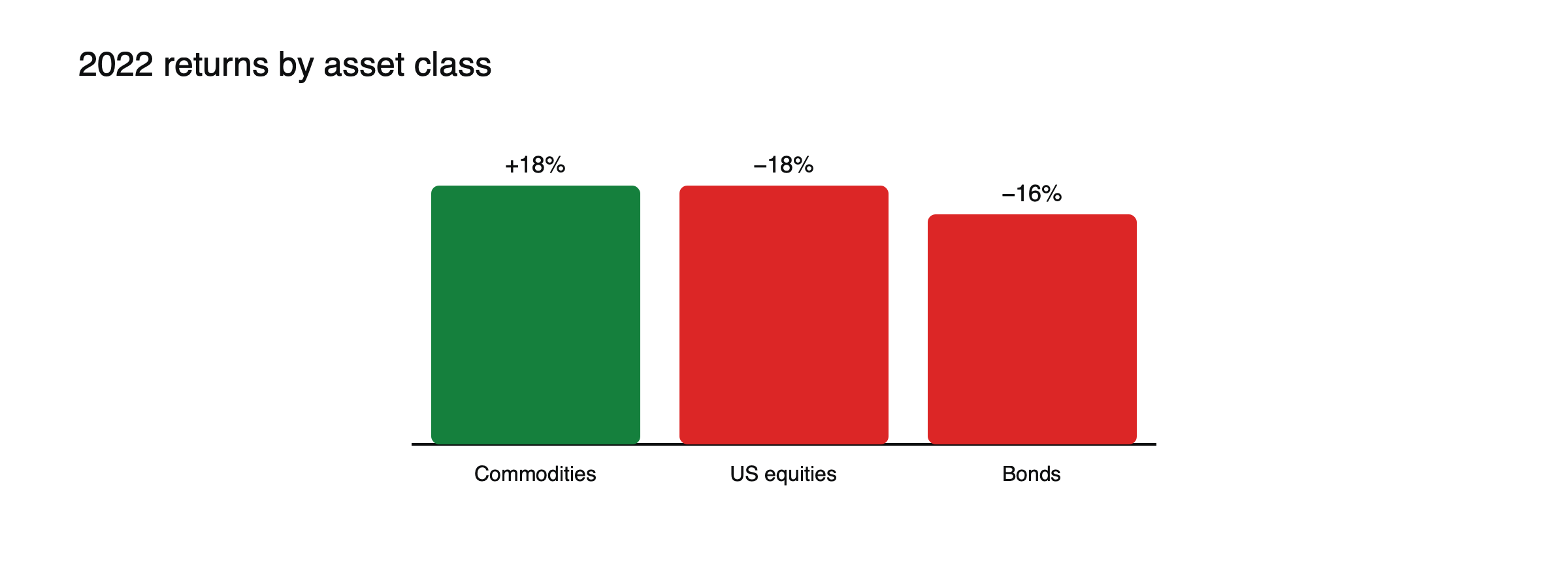
Figure: Asset class returns in 2022. Source: WisdomTree.
Inflation surprises versus expected inflation
Markets price expected inflation into interest rates and many assets in advance. What hurts portfolios is inflation that turns out higher than expected, and that kind of surprise is often caused by rising commodity prices, especially energy. Commodities therefore tend to protect against the unexpected part of inflation. When inflation is high but steady and well anticipated, they offer much less protection.
2022 in numbers
In 2022, inflation in many economies reached its highest levels in decades. A broad commodity basket gained about 18%, while US stocks fell about 18% and bonds about 16%, one of the rare years when both main asset classes lost money together. Energy led the gains as Russia’s invasion of Ukraine disrupted supplies. Gold, often seen as the classic inflation hedge, ended the year roughly flat, held back by rising real interest rates. See why gold falls when real yields rise.
When they fail
- Demand-driven slowdowns: in recessions, commodities can fall even if inflation is still high.
- Different commodities, different results: gold was about flat in 2022 while energy surged.
- Timing: commodities hedge inflation surprises, not inflation that is already priced in.
The 1970s
The decade of high inflation that followed the end of dollar-gold convertibility and the 1973 oil shock is the classic case of commodities protecting against inflation. Oil prices quadrupled within months in 1973–1974, and gold rose far above its old fixed price of $35 an ounce. Investors who held real assets did far better than those in bonds. See what caused the 1973 oil crisis.
The cost of holding
Futures-based exposure loses value in contango as positions roll; CFDs add financing. See what contango and backwardation are.
How investors use them
As a small part of a diversified portfolio rather than a full hedge, often mixing energy, metals and agriculture. See why 2022 was a test for diversification.
When gold is not the best hedge
“Gold is the best inflation hedge” did not hold in 2022, when energy did much better. See gold myths that mislead new traders and how commodity CFDs work.
Which commodities hedge what
| Commodity group | Inflation link | Main weakness |
|---|---|---|
| Energy | Direct, large weight in consumer prices | Very volatile; falls in recessions |
| Agriculture | Direct through food prices | Weather and harvest swings |
| Industrial metals | Indirect, through production costs | Highly sensitive to growth |
| Gold | Long-term store of value | Sensitive to real interest rates |
A mix usually works better than any single commodity, because each responds to a different source of inflation.
The cost of holding, worked through
Suppose a futures-based oil position is rolled every month in a market where each next contract trades about 1% higher. (Illustrative curve.) Over a year, roll costs could take roughly 10% off returns even if the front-month price ends where it started. For a cash CFD, the same carry appears as financing. An inflation hedge that costs 10% a year in calm periods needs a large inflation surprise to pay off, which is why long-term investors usually prefer unleveraged products and why CFDs suit shorter-term views. See how a futures roll adjusts a commodity CFD price.
Commodities versus other inflation hedges
Inflation-protected government bonds adjust directly with consumer prices, offering a more precise hedge with less volatility, but they can lose value when real interest rates rise, as in 2022. Real estate and infrastructure tend to protect over long periods but react slowly. Some stocks, such as producers of energy and materials, benefit from rising commodity prices. Commodities stand out for reacting fastest to supply-driven inflation surprises.
Two kinds of inflation
| Supply-driven inflation | Demand-driven inflation | |
|---|---|---|
| Typical cause | Energy or food supply shock | Strong spending, tight labor markets |
| Commodity prices | Rise first and fastest | Rise with growth, then may fall as rates rise |
| Example | 1973–1974, 2022 | Late stages of strong expansions |
| Commodities as a hedge | Usually effective | Less reliable |
A portfolio in 2022, illustrated
Using the 2022 figures, a portfolio of 60% US stocks and 40% bonds would have lost about 17.2%. Moving 10% of it into a broad commodity basket, so that it held 55% stocks, 35% bonds and 10% commodities, would have reduced the loss to about 13.7%. (Illustrative calculation using index-level returns, before costs.) The commodity slice did not prevent losses, but it softened them in a year when stocks and bonds fell together.
How much to hold
Studies of diversified portfolios typically consider modest commodity allocations, often in the range of a few percent to around ten percent, because larger holdings add a great deal of volatility. The right amount depends on how much inflation risk an investor faces, what else they hold and how comfortable they are with sharp swings. Commodities are a supporting position in most portfolios, not the core.
Ways to hold commodities
Investors can hold commodities through funds that track futures indices, funds that hold physical metals, shares of producers or leveraged instruments such as CFDs. Unleveraged funds suit long-term hedging; producers add company and stock market risk; CFDs suit shorter-term views because financing and roll costs build up over time. See how commodity CFDs work.
Common misreadings
- Expecting commodities to rise whenever inflation is high.
- Treating gold as the only inflation hedge.
- Ignoring the cost of holding futures-based positions.
Inflation, interest rates and commodities
When inflation rises, central banks usually raise interest rates. At first, commodities may keep rising because the shocks that caused inflation are still in place. But higher rates eventually slow economic activity, reduce demand for energy and metals and raise the cost of holding inventories, so commodity prices often peak and fall while inflation is still elevated. That timing is one reason investors who buy commodities after inflation is already high are often disappointed.
The long view
Over very long periods, broad commodity returns have been uneven. They have done well in decades marked by supply shocks and rising inflation, such as the 1970s and 2000s, and poorly in decades of ample supply and low inflation, such as the 1980s and 1990s. Commodities are therefore best seen as protection for particular kinds of inflation rather than a reliable long-term store of value, which gold comes closer to being over very long horizons, despite its own swings.
An inflation-hedge checklist
- Is current inflation driven by supply shocks or by strong demand?
- Are central banks raising rates fast enough to slow demand?
- Which commodities are most directly linked to the inflation you want to hedge?
- What will it cost to hold the position for the period?
- How much volatility can you absorb?
- Would an unleveraged fund serve the purpose better than a leveraged position?
- How will you know if the hedge is working?
Answering these before buying helps decide whether commodities suit the situation, and in what form.
Frequently asked questions
Should I hold commodities to protect against inflation?
Many investors hold a modest allocation as part of a diversified portfolio, accepting volatility in exchange for protection against inflation surprises. Leveraged positions are better suited to shorter-term views than to long-term hedging.
Why did commodities fall in some inflationary periods?
Because economic slowdowns can cut demand faster than inflation fades, and because prices may already reflect expected inflation.
This article is educational content and does not constitute financial, investment, legal or tax advice. Digital assets are volatile and you may lose the amount you invest.