
OTCN Fees Explained: Spreads, Commissions and Financing
Trading costs on OTCN come from spreads, commissions, overnight financing and adjustments such as rollovers. What each fee is and where to check it.
OTCN fees for trading come mainly from the spread, the gap between buy and sell prices, plus any commission per trade, overnight financing on positions held past the daily cut-off, and adjustments such as futures rollovers, dividends and currency conversion. Non-trading fees can include charges for some payment methods or inactive accounts.
[PRODUCT FACTS SHEET — Open decision 3: every OTCN-specific step, screen name, fee, limit and time in this article is a placeholder marked PFS and must be confirmed before publishing.]
Spreads
Paid on every trade; can widen in volatile or thin markets. See what spread widening is. [PFS: typical spreads by instrument and account.]
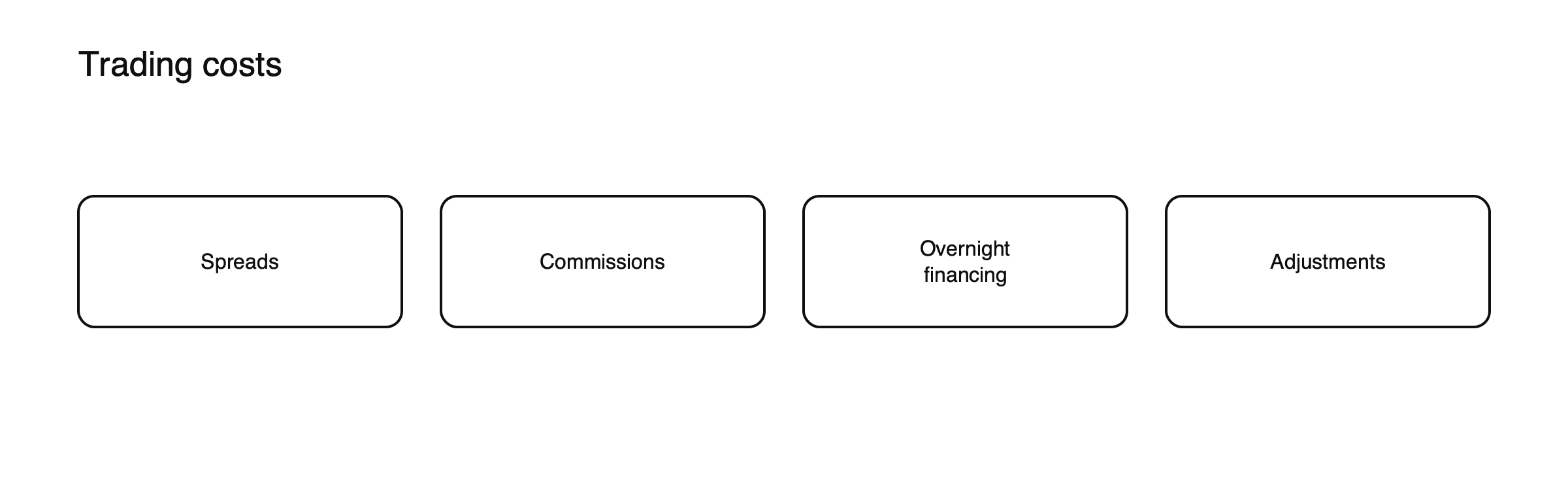
Figure: Where trading costs come from (rates to be confirmed).
Example: with a EUR/USD spread of 0.8 pips, one standard lot, where a pip is worth about $10, costs about $8 to open. On a US index CFD at $2 per point, a spread of 1 point costs $2. (Illustrative figures.) The spread is paid once, when the position is opened, because the position starts at the price you could sell at.
Commissions
Some accounts charge a fee per trade instead of, or as well as, a wider spread. Share CFDs often carry a commission based on trade value, sometimes with a minimum per trade. [PFS: OTCN commission schedule.]
Overnight financing
Charged or credited daily on open positions. The usual formula is position value × annual rate ÷ 365. On a $10,000 index position at an illustrative 6.8% a year, that is about $1.86 a night, or about $19 over ten nights. Many providers charge three nights’ financing on one weekday to cover the weekend. See how OTCN calculates margin and overnight financing. [PFS: OTCN financing benchmark, markup and weekend charging day.]
Adjustments
Dividend adjustments on stock and index CFDs, rollover adjustments on futures-based CFDs and currency conversion on trades in other currencies. See how a futures roll adjusts a commodity CFD price.
Currency conversion
If you trade an instrument priced in a currency other than your account currency, profits, losses and charges are converted, and a conversion fee may apply. [PFS: OTCN account currencies and conversion fee.]
Non-trading fees
[PFS: deposit, withdrawal and inactivity fees, if any.] See how to deposit funds into your OTCN account and how withdrawals work on OTCN.
A full cost example
Suppose you buy a US index CFD at $2 per point, a $10,000 position, and hold it for ten nights. (Illustrative figures.) The spread costs about $1, financing about $19 and there is no commission, for a total of about $20 before any dividend adjustment. If the index rises 50 points, the gross profit of $100 becomes about $80 after costs. Holding the same position for three months would raise financing to about $170, changing the picture entirely.
Costs by instrument type
| Instrument | Main costs |
|---|---|
| Currencies | Spread, overnight financing (swap) |
| Indices | Spread, financing, dividend adjustments |
| Shares | Spread or commission, financing, dividend adjustments |
| Commodities | Spread, financing or futures rollover |
| Cryptocurrencies | Spread, financing |
Fixed and variable spreads
Some accounts offer spreads that stay the same in most conditions, while others use variable spreads that move with market liquidity. Variable spreads are often tighter in calm periods but can widen sharply around news or at the market open. Fixed spreads give predictable costs but may be wider on average, and providers may still widen them in extreme conditions. [PFS: whether OTCN spreads are fixed or variable by account and instrument.]
When spreads widen
Spreads usually widen at the daily market open, around major economic releases, during holiday and overnight sessions and when markets are moving fast. Crypto CFDs can see wider spreads at weekends. Trading at these times can cost several times the usual spread, and stop orders can be filled further from their levels. See how to plan index trades around market opens and why prices gap over weekends.
Financing on long and short positions
Long positions usually pay financing, because the provider is effectively lending the money for the full position. Short positions may receive a small credit or pay a smaller charge, depending on interest rates in the relevant currency and the provider’s markup. On currency pairs, the financing, often called swap, depends on the interest rate difference between the two currencies, so one direction may earn a credit while the other pays. [PFS: OTCN long and short financing rates.]
Swap-free accounts
Some providers offer accounts without overnight financing for clients who require them, usually with other fees instead, such as an administration charge on positions held for several nights. [PFS: whether OTCN offers swap-free accounts and on what terms.]
Guaranteed stops
A guaranteed stop closes a position at exactly the chosen level, even if the market gaps, in exchange for a premium charged if the stop is triggered or when it is placed. [PFS: whether OTCN offers guaranteed stops and the premium.] See how stop-loss orders work.
Frequent and occasional traders, illustrated
A trader who opens 20 short-term index trades a month at $2 per point, paying a 1-point spread each time, spends about $40 a month on spreads and almost nothing on financing. Another who opens two $10,000 positions and holds each for 30 nights pays only about $4 in spreads but about $112 in financing. (Illustrative figures.) The same fee schedule produces very different totals depending on how you trade.
Cash and futures-based CFDs
Some indices and commodities are offered both as cash CFDs, which charge daily financing, and as futures-based CFDs, which build the cost of holding into the price and roll at expiry. For positions held for weeks or months, futures-based versions can be cheaper. See index futures vs index CFDs.
Ways to keep costs down
Trading during the most liquid hours, avoiding the first minutes after the open and major releases, choosing futures-based CFDs for longer holds and checking financing before holding positions over weekends all reduce costs. Sizing positions sensibly also limits financing, because it is charged on the full position value, not the margin.
Before you trade
- What is the current spread, and is it wider than usual?
- Is there a commission on this instrument?
- How much financing will the planned holding period cost?
- Will any dividend, rollover or conversion apply?
Reading a fee schedule
A provider’s fee schedule usually lists spreads or commissions for each instrument, financing rates or the method used to calculate them, and any non-trading charges. Typical spreads may be shown as averages, so actual spreads at a given moment can differ. Checking how each figure is calculated, and in which currency, avoids surprises. [PFS: where OTCN publishes its fee schedule and how often it is updated.]
A share CFD trade, illustrated
Suppose you buy 100 share CFDs at $50, a $5,000 position, with a commission of 0.1% subject to a $10 minimum. (Illustrative figures.) The commission is the $10 minimum, because 0.1% of $5,000 is only $5, and the same applies when you close, so the round trip costs $20 in commission before financing. Larger trades reach the percentage rate sooner, which is why minimum commissions weigh most on small positions.
A currency trade, illustrated
Suppose you buy one lot of a currency pair where the overnight swap for long positions is an illustrative charge of $7 a night. Held for five nights, including the night charged three times for the weekend, the position pays seven nights of swap, about $49, on top of the spread paid when opening. If the swap for that direction were a credit instead, the position would earn a small amount each night. See what moves currency prices.
A crypto CFD trade, illustrated
Suppose you buy 0.1 bitcoin through a CFD at $60,000, a $6,000 position, with a spread of $60 per bitcoin and financing at an illustrative 8% a year. (Illustrative figures.) The spread costs about $6, and holding the position for 30 nights, including weekends, costs about $39 in financing, so the trade needs bitcoin to rise about 0.75% just to cover costs. Because crypto trades every day, financing usually applies every night. See what a crypto CFD is. [PFS: OTCN crypto spreads and financing.] Holding the same position for three months would raise total financing to about $118, which is why crypto CFDs are usually better suited to shorter holding periods than long ones.
How to estimate the total
Add the spread, commission and expected financing for your holding period. For short trades, spreads and commissions matter most; for longer holds, financing usually dominates. See how CFD costs add up and what a CFD is.
Frequently asked questions
Which cost matters most?
It depends on how long you hold positions: spreads for short-term trades, financing for positions held for weeks or months.
Where can I see the current costs?
In each instrument’s specification on the platform. [PFS: where OTCN displays spreads, commissions and financing rates.]
[RISK WARNING — Open decision 2: approved CFD and leverage risk warning to be inserted here before publishing.]
This article is educational content and does not constitute financial, investment, legal or tax advice. Digital assets are volatile and you may lose the amount you invest.