
What Is the DAX 40?
The DAX tracks the 40 largest Frankfurt-listed companies and includes dividends in its main version. How it is built, what moves it and how it trades.
The DAX 40 is Germany’s main index, tracking the 40 largest Frankfurt-listed companies that meet quality and profitability rules; it grew from 30 members in September 2021. Unusually, its headline version includes reinvested dividends, so it can look stronger over time than price-only indices such as the FTSE 100.
How it is built
- 40 members selected by free-float market capitalization.
- Profitability rule: new members need positive EBITDA in the two latest fiscal years.
- Coverage: over three quarters of the market value of Frankfurt’s regulated market.
- Administered by STOXX since 2019.
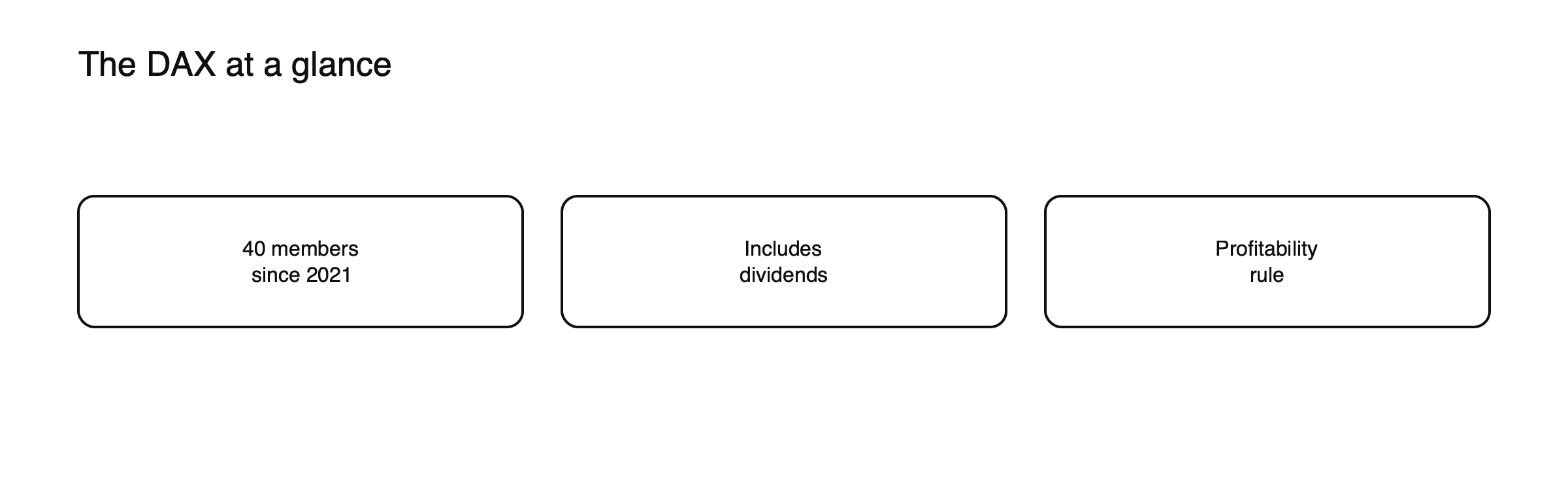
Figure: The DAX at a glance.
From 30 to 40 members
The DAX was launched in 1988 with 30 members. In September 2021 it expanded to 40, partly in response to the collapse of payments company Wirecard, a DAX member that went into insolvency in 2020 after admitting that billions of euros on its balance sheet probably did not exist. The reform added stricter quality rules, including the profitability requirement for new members and requirements for timely publication of audited reports, aiming to make the index more representative and its members more reliable.
Performance vs price index
The main DAX includes dividends; a separate price index (DAX PR) excludes them. When comparing with other indices, check which version you are looking at.
Why total return matters, illustrated
Suppose the DAX’s members pay dividends worth about 3% of the index each year. (Illustrative figure.) Over ten years, reinvesting those dividends adds roughly a third to the index’s growth compared with a price-only version, all else equal. Comparing the DAX with the FTSE 100 or S&P 500 without allowing for this difference makes Germany’s market look stronger than it really was relative to the others. For CFD traders, the practical effect is that DAX CFDs usually have no dividend adjustments, because the index does not drop when members go ex-dividend. See how index dividends are adjusted.
What moves it
German and global manufacturing, exports, autos and chemicals, energy prices, euro area data such as manufacturing surveys and the IFO business climate, and ECB policy. See why the DAX is so sensitive to global trade.
How it is traded. Through ETFs, futures and CFDs, often called “Germany 40.” Priced in euros, so non-euro traders also take currency risk. See how stock index CFDs work.
See what the EURO STOXX 50 is and what the FTSE 100 is.
Sector mix
The DAX is weighted toward industrial companies, carmakers, chemicals, software, insurance and financials, with relatively few energy or mining companies. Several members earn much of their revenue abroad, especially from the United States and China, so global demand and trade policy matter as much as the German economy. A single large software company and several insurers carry significant weights, which can make the index react to sector news beyond manufacturing.
Trading a Germany 40 CFD, worked through
With the DAX at an illustrative 24,000, a Germany 40 CFD at €1 per point is a position worth about €24,000, needing about €1,200 of margin at the 20:1 retail limit for major indices. A 300-point move, about 1.25%, gains or loses €300. For an account in another currency, results are converted from euros, adding currency risk. (Illustrative trade.) See how to calculate the value of a point on an index CFD.
Trading hours
The DAX’s cash session on the Xetra platform runs from 9:00 a.m. to 5:30 p.m. Frankfurt time, and DAX futures trade for longer hours. Many CFD providers quote Germany 40 for extended hours or almost around the clock, pricing from futures outside the cash session. The open often reacts to overnight moves in US and Asian markets, and European data such as business surveys move the index in the morning.
Exposure to China and global trade
German exporters rely heavily on China, both as a market for cars and machinery and as a competitor. Signs of weaker Chinese demand or new trade barriers often weigh on the DAX more than on other European indices. Equally, Chinese stimulus or a trade truce can lift it sharply.
The euro effect, illustrated
Suppose a German machinery maker earns $5 billion a year in the United States. At EUR/USD 1.20, that is about €4.2 billion; at 1.05, about €4.8 billion, roughly 14% more, with no change in its American sales. (Illustrative figures.) A weaker euro therefore tends to support the DAX’s exporters, while a sharp rise in the euro can weigh on them, although the effect is smaller than the pound’s effect on the FTSE 100 because more of German companies’ costs are also abroad.
Business surveys
German business surveys move the DAX because they give early signals about the economy. The IFO business climate index, the ZEW survey of financial experts’ expectations and the monthly purchasing managers’ indices for manufacturing and services are watched closely. Surprises in these surveys, especially in manufacturing, can move the index in the morning session, often more than official data released later.
Carmakers
Germany’s large carmakers are important DAX members and face several pressures at once: the shift to electric vehicles, competition from Chinese manufacturers, demand in China and trade policy, including tariffs in the United States and Europe. News on any of these can move car shares sharply and, through them, the index.
DAX compared with the EURO STOXX 50
Both are dominated by large European companies and priced in euros, but the DAX is purely German and includes dividends in its headline version, while the EURO STOXX 50 spans several countries and is a price index. The DAX has more industrial and chemical exposure; the EURO STOXX 50 more French luxury goods and southern European banks. Their performance can differ noticeably when German manufacturing or Chinese demand dominate the news. See what the EURO STOXX 50 is.
Common misreadings
- Comparing DAX returns with price-only indices.
- Expecting dividend adjustments on DAX CFDs.
The 2022 energy shock
Germany relied heavily on Russian natural gas before 2022. When supplies were cut and European gas prices rose to about ten times normal levels, energy-intensive industries such as chemicals faced soaring costs and fears of rationing, and the DAX fell sharply for much of the year. The episode showed how dependent German industry, and the index, is on affordable energy.
The open and volatility
The DAX often moves sharply in the first minutes of the Xetra session, as it absorbs overnight news from Asia and US futures. Many traders let an opening range form before acting, and size positions for the larger moves typical of the first hour. See how to plan index trades around market opens.
Weight caps
To prevent a single company from dominating, the DAX limits the weight of any one member, a rule strengthened after Volkswagen’s weight briefly surged during the 2008 short squeeze. Caps are applied at regular reviews, so a company that grows quickly can temporarily exceed its target weight until the next adjustment. See how Volkswagen briefly became the world’s most valuable company. For traders, the point is that the DAX cannot become as concentrated in one company as some US indices have.
Frequently asked questions
Why does the DAX look so strong over long periods?
Partly because its headline version includes reinvested dividends, unlike most indices it is compared with.
Is the DAX a good gauge of the German economy?
Only partly. Many members earn most of their revenue abroad, so the index reflects global conditions as much as domestic ones.
This article is educational content and does not constitute financial, investment, legal or tax advice. Digital assets are volatile and you may lose the amount you invest.
Sources
- DAX (40 largest companies on Frankfurt’s regulated market; includes dividends; increased from 30 to 40 on September 20, 2021; positive EBITDA rule; STOXX since 2019) — STOXX
- What is the DAX index (dividends reinvested; FTSE 100 quoted as price return; FTSE heavier in energy, mining and financials; German data drivers) — CMC Markets
- All you need to know about the DAX (expanded to 40 in September 2021; much of FTSE 100 income from overseas; DAX less so) — Pepperstone
- ESMA adopts CFD measures (20:1 for major indices; 10:1 for non-major equity indices) — Finadium
- Europe’s energy crisis (gas reached about ten times normal levels in 2022) — Foreign Policy, August 2022